.svg)


How to Use AI to Rebuild the Startup Operating System from SXSW 2026


Key Takeaways

- Shipwell CEO & Co-Founder Greg Price joined Alex Cohen, Pranitha Patil, Alana Ackerson, and Aryaman Khandelwal at SXSW 2026 to share how startups are using AI.
- AI fluency is now a measurable skill, not a soft one. Companies like Vercel require every employee to spend $1,000 in AI tokens monthly, and startups are evaluating prompt quality in job interviews.
- The most effective teams aren't adding AI to existing workflows—they're restructuring entirely around it, from engineering to GTM to customer support.
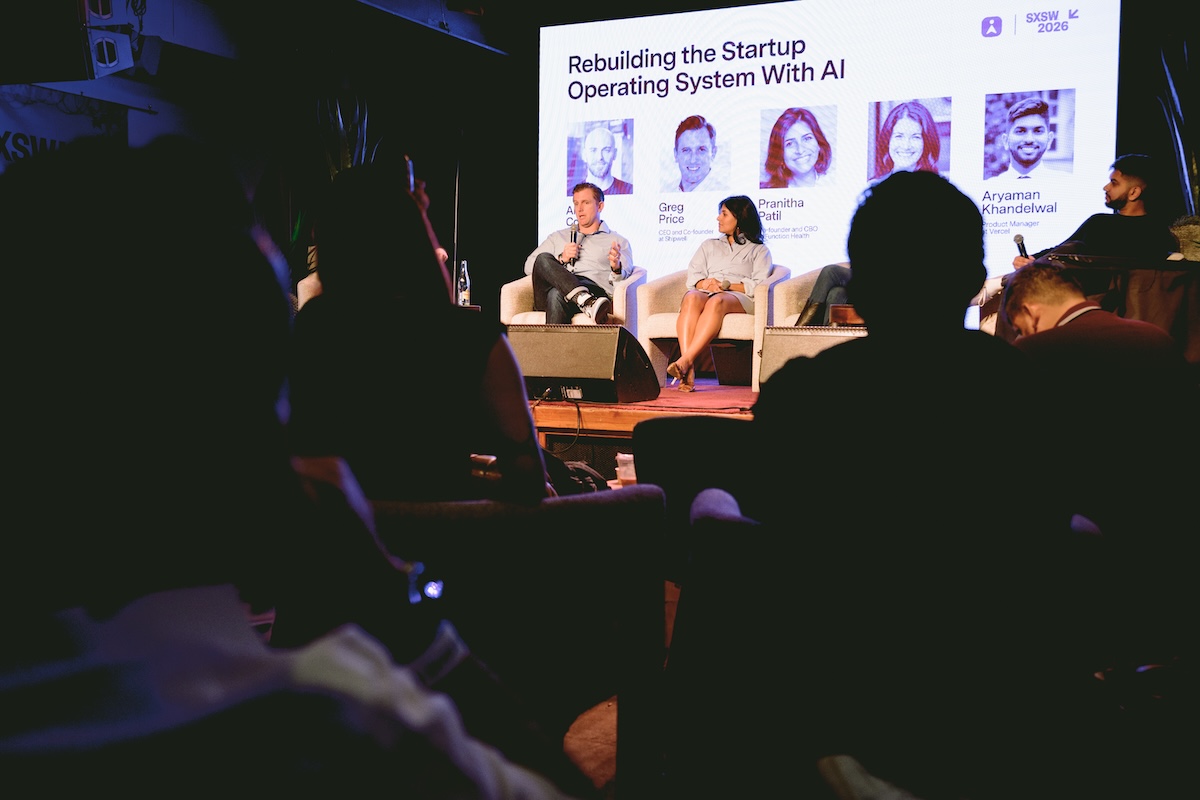
Over 100 founders and investors packed into Antone's Nightclub as part of SXSW 2026, for Superhuman’s session "Rebuilding the Startup Operating System With AI." Moderated by Alex Cohen of Hello Patient, the panel brought together Pranitha Patil (Function Health), Alana Ackerson (Figure), Aryaman Khandelwal (Vercel) and I to discuss how AI is reshaping the way early-stage companies operate.
What followed wasn't a product pitch or a theoretical debate, but rather, an honest exchange between founders actively doing the work—with the hard-won lessons, missteps, and wins to back it up.
Is AI Fluency Now a Baseline Expectation?
In short, yes. AI proficiency is not a soft skill, and startups are tracking usage with hard metrics. Vercel, for example, expects every employee to spend $1,000 in AI tokens monthly. The AI;DR: if you're not actively automating your job, you're already behind.
Function Health takes a similar approach, requiring teammates to identify how AI can automate existing tasks before approving new headcount. The question isn't around whether your team uses AI—it's how well they use it.
Has the Hiring Bar Really Shifted?
The panel's consensus: yes, and the shift is more nuanced than most people expect. Startups are no longer screening for technical experience alone. They're looking for judgment—specifically, the ability to direct AI toward high-quality output rather than simply generating the volume it’s already known for.
One candid moment I shared was around a recent experience I had hiring for Shipwell: I caught a candidate completing their entire interview using an AI bot. The tell? Their eyes moved left to right the whole time. It got a laugh from the room, but the takeaway was very real—how a candidate uses AI in an interview reveals exactly how they'll use it on the job.
Can Junior Talent Perform at Senior Levels With AI?
AI is enabling less experienced engineers to produce at unprecedented output levels, sometimes outpacing senior developers in raw volume. The trade-off is without strong review processes, quality breaks down fast.
The opportunity is significant, but it requires intent. Giving junior team members the power of AI without the structure to support it is like handing someone a sports car without teaching them to drive.
Why Does Prompt Quality Matter as Much as Code Quality?
How you interact with AI is becoming just as important as what you build with it. Prompt quality is now a proxy for technical judgment, and my fellow panelists shared that they ask candidates to show their prompts during interviews (not just their outputs.)
This reflects the broader truth that AI amplifies thinking. The quality of what comes out is directly tied to the quality of what goes in. Prompting is the new programming layer.
How Are AI-Native Startups Actually Restructuring?
The most forward-thinking teams aren't injecting AI into existing workflows. They're redesigning their operations around it, from product development to go-to-market to internal collaboration. AI is the foundation of the modern startup operating system.
At Shipwell, we’ve already taken this from idea to execution. Our team built an internal AI assistant (named Zeus) that lives in Slack that pulls from multiple data sources to answer product questions, investigate production incidents, generate code, and open pull requests—all without leaving the communication channel our team uses most often.
In practice, this can take a variety of forms, like investigating a production incident and tracing it to its root cause in real time, turning a 20-minute customer support investigation into a 30-second answer, breaking down product epics into scoped tickets without needing immediate engineering insight, or keeping marketing messaging consistent across every channel without starting from scratch.
Zeus doesn't replace our people. It makes every single one of them faster.
What's Greg Taking Away From the Conversation?
"It was an incredible panel and discussion. I walked away even more energized about where AI is headed, and even more confident in what we're building at Shipwell. We're not just talking about AI, we're already leading by enabling every team to operate with it at the core."
Interested in how Shipwell is putting AI to work across the supply chain? See what we're building.
Frequently Asked Questions
What was the SXSW 2026 panel "Rebuilding the Startup Operating System With AI" about?
Startup founders Alex Cohen (Hello Patient), Greg Price (Shipwell), Pranitha Patil (Function Health), Alana Ackerson (Figure), and Aryaman Khandelwal (Vercel) shared practical lessons on integrating AI into product development, go-to-market strategies, and internal operations. The core thesis: AI isn't something you add to your startup—it's something you build around.
How are leading startups measuring AI fluency on their teams?
With hard metrics. Vercel requires employees to spend $1,000 in AI tokens monthly. Function Health requires teams to identify AI-driven automation opportunities before approving new headcount. AI proficiency is tracked, not assumed.
How has AI changed the startup hiring process?
The bar has shifted from experience to judgment. Startups now evaluate how candidates use AI; prompt quality has become a signal of design thinking and decision-making ability. Volume of output matters less than quality of direction.
What's the biggest risk of moving fast with AI at an early stage?
Prioritize tools that integrate into existing workflows and have a measurable impact on output quality or speed. Depth of use matters more than breadth of adoption.
Does AI level the playing field for startups, or widen the competitive gap?
Both, depending on execution. Smaller teams can now move at speeds previously reserved for well-resourced companies. But for those who build strategically around AI, the advantage compounds over time.